Table of Contents
- What Actually Drives Bulk Pricing for Research Peptides
- Why Third-Party Tested Peptides Command a Higher Line Item
- Evaluating cGMP-Certified Peptide Manufacturers Before You Commit
- HPLC and Mass Spectrometry Peptide Verification: Reading the Data You Pay For
- Bulk Pricing Comparison Table: What Each Tier Actually Buys
- Stability, Storage and Shelf Life: The Hidden Cost in Bulk Orders
- Regulatory Landscape for Research Chemicals in Bulk Procurement
- Frequently Asked Questions
Last Updated: September 16, 2026
What Actually Drives Bulk Pricing for Research Peptides
Bulk pricing for research peptides is determined by three variables that compound on each other: synthesis scale, lot size, and the purity threshold you specify. A 98% pure peptide at 10 mg costs far more per milligram than the same sequence at 100 mg, but the gap narrows faster than most buyers expect once you cross into gram-scale production.
At Minuteman Peptides, we see this play out constantly in quotes. Two labs request the same sequence. One orders a single vial for a pilot assay; the other commits to a multi-lot supply for an 18-month study. Their per-milligram costs differ by an order of magnitude, and the reason isn’t markup. It’s the fixed cost of synthesis, purification, and analytical testing spread across a larger batch.
Below, we break down exactly what moves the line item, how to read the data behind a quote, and where hidden costs hide in bulk orders.
Purity Thresholds, Scale and Lot Size
Purity is the single largest cost driver. Moving from 95% to 98% purity typically requires an additional round of high-performance liquid chromatography (HPLC) purification, and each round costs time and yield. A crude synthesis might yield 70-80% of theoretical peptide; every purification pass recovers less of that material. You pay for what’s discarded.
Scale works in the opposite direction. Synthesis resin, reagents, and labor are largely fixed costs per batch, so a 500 mg batch carries nearly the same overhead as a 100 mg batch. Split across five times the material, the per-milligram price drops sharply. This is why vendors structure bulk pricing in tiers rather than offering linear discounts.
Lot size and sequence complexity add the final layer. Longer sequences, unusual amino acid derivatives, and sequences prone to aggregation all reduce yield. A difficult sequence may cost two to three times more than a routine one at identical scale and purity.
Ask for the crude yield and purification recovery rate on your specific sequence before you accept a bulk quote. Two vendors quoting the same purity can have very different underlying economics, and the vendor that knows its yield data is usually the one with tighter process control.
Cost Per Milligram vs. Cost Per Vial
Cost per vial is a marketing number. Cost per milligram is the number your budget actually cares about.
A vial is just a container. What matters is how much peptide that vial holds, at what purity, with what analytical documentation. Vendors that quote only per-vial pricing make comparison nearly impossible, because vial sizes vary from 5 mg to 1 g or more.
When you normalize to cost per milligram, three things become visible:
- Purity-adjusted cost: A cheaper 95% peptide may cost more per usable milligram than a 98% peptide once you account for the impurities you’re discarding or working around.
- Scale efficiency: The per-milligram price should drop as lot size increases. If it doesn’t, you’re paying for convenience, not manufacturing.
- Testing overhead: Third-party analytical testing is a per-lot fixed cost. Larger lots amortize it better, which is one reason bulk orders from a properly tested supplier are more economical than they first appear.
For repeatable in vitro work, the per-milligram view almost always favors larger lots from a supplier with documented batch testing over smaller, cheaper vials from a supplier with none.
Why Third-Party Tested Peptides Command a Higher Line Item
Third-party tested peptides cost more because independent verification is a real expense, not a marketing layer. Every lot that goes to an ISO/IEC 17025 certified laboratory for HPLC and mass spectrometry analysis carries a testing fee, a shipping cost, and a turnaround delay. That cost is baked into the unit price.
The question is whether it’s worth paying. For research where repeatability matters, yes, without qualification. A certificate of analysis (COA) from an independent lab tells you the actual purity of the lot you received, its molecular weight confirmation, and often its appearance and solubility characteristics. An in-house COA from the same facility that synthesized the peptide tells you what the manufacturer claims, which is a different thing entirely.
Here’s what most buyers miss: a COA is only as good as the laboratory that issued it. Look for the testing lab’s accreditation, the analytical method used, and whether the report is lot-specific.
A COA that lists purity but omits the analytical method, the lot number, or the testing laboratory’s identity cannot be verified. If a batch fails your assay and you need to trace the cause, that COA gives you nothing to work with. Insist on lot-specific reports with named testing labs.
Evaluating cGMP-Certified Peptide Manufacturers Before You Commit
cGMP-certified peptide manufacturers operate under current Good Manufacturing Practice, a quality system that governs facility conditions, equipment calibration, documentation, personnel training, and process control. The certification matters because it constrains how a peptide is made, not just what comes out at the end.
- Confirm the manufacturing facility is cGMP-certified and request the certifying body’s name
- Verify the facility location matches where your peptide is actually synthesized
- Request lot-specific COAs from an ISO/IEC 17025 accredited third-party lab
- Ask for the HPLC chromatogram and mass spectrometry report, not just a summary purity figure
- Confirm the supplier’s policy on failed batches, including replacement or refund terms
- Request a sample lot before committing to a multi-lot supply agreement
HPLC and Mass Spectrometry Peptide Verification: Reading the Data You Pay For
HPLC and mass spectrometry peptide verification answers two separate questions. HPLC tells you how pure the peptide is. Mass spectrometry tells you whether the molecule is the right one. (Source: ISO/IEC 17025 standards for testing and calibration laboratories)
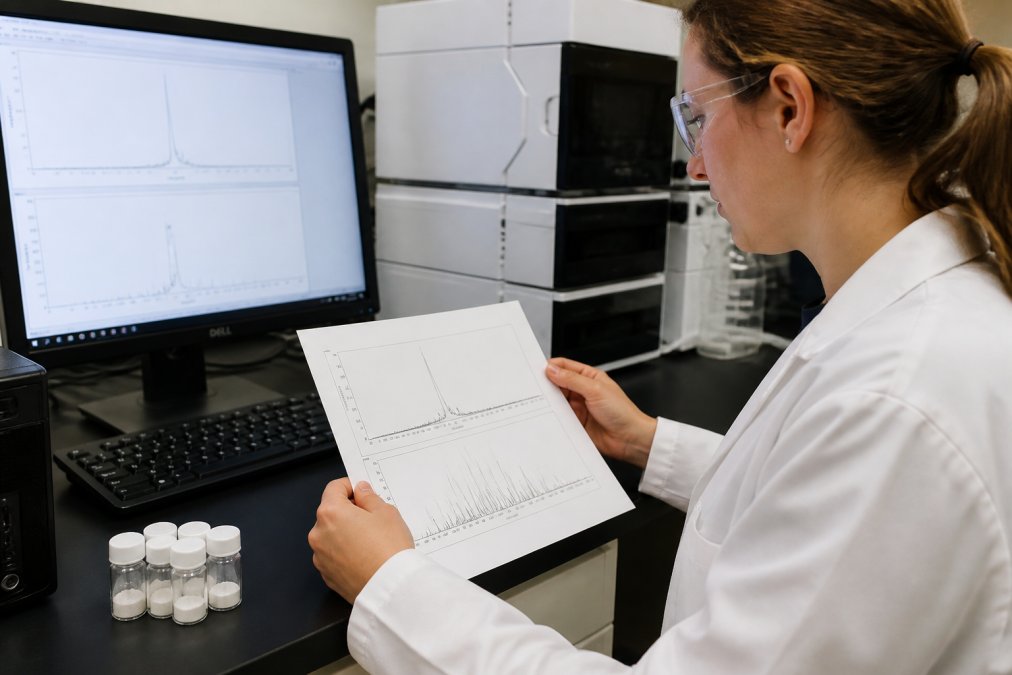
- The chromatogram itself, not just a percentage. A purity figure without the underlying trace can hide peak shape problems.
- The mass spec spectrum, with the observed mass clearly labeled against the theoretical mass.
Purity percentage alone is not verification. You need the HPLC trace to judge peak quality and the mass spec spectrum to confirm molecular identity. Both should be lot-specific and issued by an accredited independent lab.
Bulk Pricing Comparison Table: What Each Tier Actually Buys
Bulk pricing for research peptides scales in tiers, and each tier buys a different level of documentation, testing, and process control. The table below maps typical tier structures to what they include, so you can match a tier to your study’s requirements rather than guessing.
| Tier | Typical Lot Size | Purity Range | Testing Included | Best For |
|---|---|---|---|---|
| Sample | 5-10 mg | 95%+ | In-house or summary COA | Assay pilot, solubility check |
| Standard | 25-100 mg | 95-98% | Third-party HPLC, lot-specific COA | Single-study in vitro work |
| Bulk | 250 mg-1 g | 98%+ | Third-party HPLC + mass spec, lot-specific COA | Multi-batch studies, 6-18 month timelines |
| Custom / large-scale | 1 g+ | 98%+ | Full analytical package, custom QC criteria | Contract research, method development |
Stability, Storage and Shelf Life: The Hidden Cost in Bulk Orders
Stability and degradation factors are the hidden line item in bulk procurement. A peptide that degrades in storage costs you the material, the testing, and the experiment time lost to a failed run.
What degrades a peptide:
- Moisture exposure: hydrolysis cleaves the peptide backbone
- Repeated freeze-thaw cycles: aggregation and precipitation
- Light exposure: oxidation of sensitive residues
- Improper pH in solution: accelerated degradation for some sequences
Request stability testing data for your specific sequence, not a generic peptide. Degradation rates vary widely by sequence, and a supplier who can provide sequence-specific stability data has done the analytical work that a generic claim skips.
Regulatory Landscape for Research Chemicals in Bulk Procurement
Research chemicals occupy a specific regulatory position: they are sold for laboratory and analytical use only, not for human or animal consumption. That distinction is not a formality. It defines what the product is, how it can be sold, and what claims a supplier may make.
For bulk procurement, the practical implications are:
- Labeling: products must be clearly marked for research use only
- Documentation: lot-specific COAs and analytical reports support the research-use designation
- Traceability: batch records and testing data let you document the chain of custody for your own institutional compliance
- No therapeutic claims: suppliers may not market research peptides for human use, and researchers should not treat them as such
Frequently Asked Questions
What should I look for when comparing bulk pricing for research peptides?
Look past the headline price per milligram. Ask for lot-specific data: a Certificate of Analysis showing HPLC purity, mass spectrometry confirmation of molecular weight, and the name of the ISO/IEC 17025 certified lab that ran the tests. Compare cost per verified milligram, not cost per vial. Also weigh batch-to-batch consistency, replacement terms, and whether the manufacturer is cGMP-certified. A cheaper quote from a supplier without verifiable testing usually costs more when an experiment has to be repeated.
How does third-party testing affect the cost of research peptides?
Independent testing adds a real line item. Each batch must be analyzed by an ISO/IEC 17025 certified laboratory using HPLC and mass spectrometry, and that cost is built into the price. Suppliers who skip third-party testing or test only once and reuse the same COA can quote lower numbers. For repeatable in vitro work, the premium buys traceable lot-specific data and reduces the risk of a failed run, which is usually the larger expense.
Are there specific regulatory standards for purchasing research peptides in bulk?
Research peptides are sold as laboratory reagents, not drugs or supplements, so they fall outside FDA drug approval pathways. There is no federal bulk-purchase license for qualified laboratories. What matters is that the supplier manufactures under cGMP guidelines and documents analytical testing. Institutions often add their own procurement rules for research chemicals. Check with your environmental health and safety office and the supplier’s compliance documentation before placing a large order.
How can labs verify the purity of bulk peptide orders after delivery?
Request the lot-specific COA before the shipment ships and confirm the batch number on the vial matches the document. Run your own in-house HPLC against a reference standard if your lab has the capability, and spot-check mass spectrometry for molecular weight confirmation. If results deviate from the stated purity threshold, document the discrepancy and contact the supplier immediately. Reputable cGMP-certified peptide manufacturers provide replacement or refund terms for out-of-spec batches.