Table of Contents
- What cGMP Certification Actually Means for Research Peptides
- How to Read a Peptide Certificate of Analysis
- HPLC and Mass Spectrometry Peptide Verification Explained
- Research Peptide Sourcing Best Practices for Labs
- Stability, Storage, and Degradation Factors
- Regulatory Landscape and Laboratory Use Disclaimers
- Frequently Asked Questions
Last Updated: September 16, 2026
What cGMP Certification Actually Means for Research Peptides
Current Good Manufacturing Practice (cGMP) is the FDA’s regulatory framework requiring manufacturers to control every stage of production, from raw material intake to final packaging, so that identity, strength, quality, and purity stay consistent batch after batch. For research peptides, that means documented synthesis protocols, validated equipment, environmental monitoring, and lot-specific records rather than a one-time test result.
The gap between a genuine cGMP facility and a supplier who prints “cGMP” on a product page is enormous when you buy cGMP certified research peptides online. When you buy cGMP certified research peptides online, you are paying for an auditable paper trail, not a badge. The FDA’s Current Good Manufacturing Practice regulations set the baseline expectations for facility controls, and any serious supplier should be able to show how they meet them.
At Minuteman Peptides, every lot is produced in a cGMP-certified, US-based facility and then independently verified by an ISO/IEC 17025 certified laboratory. That second layer matters, because self-reported purity tells you nothing about what actually shipped.
How to Verify a Supplier’s cGMP Status
Verification starts with asking for the facility registration and the audit history, not a marketing page. A legitimate operation can name the manufacturing site and describe its inspection record. If a supplier deflects or points only to a logo, treat that as a red flag.
A practical checklist for vetting any supplier:
- Request the facility’s cGMP registration or audit documentation
- Confirm the third-party lab holds ISO/IEC 17025 accreditation
- Ask whether testing is lot-specific or done once on a reference batch
- Verify the COA matches the lot number on the vial you receive
- Check that the synthesis site and testing site are both disclosed
What most buyers miss is that cGMP compliance is a facility-level property, not a product-level claim. A supplier can sell a perfectly good peptide and still lack the controls that make results repeatable across an 18-month study.
How to Read a Peptide Certificate of Analysis
A Certificate of Analysis (COA) is the lot-specific document recording what was tested, the method used, the measured result, and the acceptance criteria for that batch. Reading it correctly is the single most useful skill for anyone sourcing research compounds.
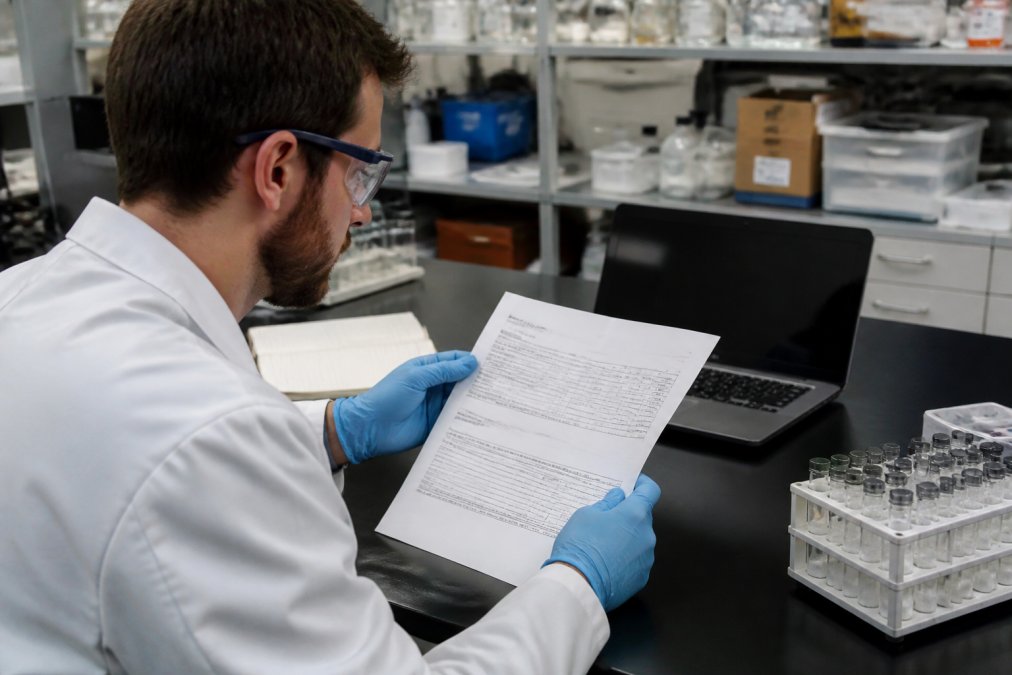
Start with three fields: the lot number, the test method, and the purity result. The lot number must match your vial exactly. The method should name HPLC for purity and mass spectrometry for identity. The purity figure should come with the analytical conditions, not a bare number.
Then check the identity confirmation. A peptide sequence is only verified when the observed molecular weight matches the theoretical mass for that sequence.
A COA without a lot number is worthless. Suppliers sometimes circulate a single “representative” COA across many batches. If the document cannot be tied to the vial in your hand, it verifies nothing about your experiment.
HPLC and Mass Spectrometry Peptide Verification Explained
HPLC and mass spectrometry peptide verification works as a two-part system: HPLC separates the components in a sample and measures how much of the target peptide is present, while mass spectrometry confirms that the molecule’s mass matches the expected sequence. Together they answer two different questions, purity and identity, and you need both.
Reading HPLC Chromatograms and Mass Spec Peaks
On an HPLC chromatogram, the target peptide appears as the main peak, and the purity percentage reflects how much of the total peak area that main peak occupies. Smaller surrounding peaks indicate related impurities, truncation products, or residual solvents.
| Document Element | What It Confirms | What to Check |
|---|---|---|
| Lot number | Traceability | Matches your vial label |
| HPLC purity % | Purity threshold | Method and wavelength disclosed |
| Mass spec result | Peptide sequence identity | Observed vs. theoretical mass |
| Test date | Recency | Aligns with batch production |
| Lab accreditation | Testing integrity | ISO/IEC 17025 reference |
Research Peptide Sourcing Best Practices for Labs
Research peptide sourcing best practices come down to treating every supplier claim as a hypothesis until documentation proves it. The labs that avoid trouble are the ones that build verification into procurement rather than trusting a product listing.
A few habits separate reliable sourcing from guesswork:
- Buy from suppliers who disclose both the synthesis site and the independent testing lab
- Require lot-specific COAs before placing a recurring order
- Retain a sample from each lot for your own records
- Track purity and identity data across batches to catch drift early
- Confirm the supplier’s replacement policy before committing to a long study
Ask for the COA for the specific lot before it ships, not after. Suppliers with nothing to hide provide it without hesitation, and you can flag a purity or identity problem before the material reaches your bench.
Stability, Storage, and Degradation Factors
Peptide stability depends on the physical form, storage temperature, and how often the material is exposed to air and moisture. Most research peptides ship as a lyophilized powder precisely because the dry state resists degradation far better than solution.
Key factors that drive degradation:
- Temperature: warmer storage speeds hydrolysis and oxidation
- Moisture: residual water in a poorly sealed vial promotes breakdown
- Light: UV exposure damages certain amino acid residues
- pH: reconstitution buffers outside the stable range shorten shelf life
- Handling: frequent opening introduces contaminants and moisture
Regulatory Landscape and Laboratory Use Disclaimers
Research chemicals occupy a specific regulatory space: they are sold for laboratory investigation and are not approved for human or animal consumption. Suppliers operating legitimately label products accordingly and restrict claims to research applications.
What “Research Use Only” Actually Means
An RUO label is a legal designation, not a marketing preference. It signals three things:
- The material is intended for in vitro or laboratory investigation only
- It is not intended for diagnostic, therapeutic, or human consumption use
- The supplier is not making drug claims and is not subject to the FDA’s drug approval pathway for that product
How the Regulatory Picture Varies by Compound
Not all research peptides sit in the same regulatory bucket. A few patterns worth understanding:
- Generally recognized research chemicals, sold openly as RUO, with clear labeling and no therapeutic claims
- Compounds with additional controls, some materials fall under specific scheduling or import restrictions, and a responsible supplier documents that status rather than obscuring it
- Compounds with FDA-approved analogs, the research version is still RUO, but the existence of an approved drug with a similar structure can attract additional scrutiny
What a Compliant Supplier Documents
For laboratory managers building a defensible procurement file, look for these elements on every order:
- A clear RUO statement on the product label and the accompanying documentation
- No therapeutic, dosing, or human-use language anywhere in the marketing or packaging
- Lot-specific analytical data (COA) tied to the vial
- A stated intended-use restriction that matches how your lab actually uses the material
- Records that let you trace the batch back to the manufacturing site
What Buyers Should Not Do
- Do not purchase research peptides for personal use, self-administration, or any human application
- Do not rely on a supplier’s marketing language as a substitute for your own institutional review
- Do not assume that “legal to buy” means “legal to use in humans”, those are separate questions
- Do not ignore your institution’s own chemical hygiene and procurement policies, which may be stricter than federal rules
“Research use only” is a legal designation, not a suggestion. Purchasing research peptides for human consumption is outside the intended use, may violate federal law depending on the compound, and voids any quality guarantee the supplier offers.
Minuteman Peptides ships every order with a transparent COA and offers free shipping on orders over $200, with secure payment options for institutional buyers.
Frequently Asked Questions
What does cGMP certification mean for research peptides?
cGMP stands for current Good Manufacturing Practices, a set of FDA-enforced standards covering facility design, equipment, personnel training, and documentation. For research peptides, cGMP certification means the manufacturer follows written procedures for every batch, from raw material intake through lyophilization and final packaging. It does not mean the peptide is approved for human use. It means the process is controlled and traceable, which matters when your experiments require repeatable results across lots.
How can I verify a peptide supplier’s third-party testing results?
Ask for the ISO/IEC 17025 certification of the testing lab, not just the supplier. ISO/IEC 17025 is the international standard for testing and calibration laboratories, and accredited labs can be verified through the accrediting body’s public directory. Then match the lot number on your vial to the COA. A legitimate supplier provides lot-specific data, not a generic report reused across batches. If the COA lacks a lot number, unique test date, or lab contact information, treat the results as unverified.
Why is HPLC and mass spectrometry testing critical for research compounds?
HPLC separates the components in a sample and reports purity as a percentage, while mass spectrometry confirms the molecular weight matches the expected peptide sequence. Together they answer two different questions: how much of the sample is the target peptide, and is the peptide actually the correct molecule. A purity reading alone can be misleading if the wrong sequence is present. Requesting both results on a lot-specific COA gives you the data needed to judge whether a batch meets your purity threshold.
What are the risks of purchasing non-certified research peptides?
Without cGMP documentation and independent testing, you have no way to confirm purity, identity, or sterility of the lyophilized powder. Common problems include truncated sequences, residual solvents, and batch-to-batch inconsistency that ruins experimental repeatability. Non-certified suppliers may also ship without lot traceability, so if a batch fails you cannot trace it back. For in-vitro studies, that means wasted reagents, unreliable data, and potentially months of lost work. Always request a COA before committing to a supplier.
Finding a supplier who can back a cGMP claim with real documentation, lot-specific COAs, and independent testing is harder than it should be. Minuteman Peptides addresses that directly: cGMP-certified US-based manufacturing, ISO/IEC 17025 certified third-party testing, and verified HPLC and mass spectrometry results on every batch. Get started with Minuteman Peptides and source research peptides with the purity and repeatability your in vitro studies require.