Table of Contents
- Why Peptide Batch Consistency Testing Matters for Research
- How to Interpret HPLC and Mass Spectrometry Data for Peptides
- Peptide Certificate of Analysis Interpretation
- Analytical Testing Methods Overview
- Peptide Stability Testing Protocols and Degradation Analysis
- Independent Third-Party Validation and Raw Material Quality Control
- Building a Batch Consistency Testing Protocol for Your Lab
- Frequently Asked Questions
Last Updated: September 19, 2026
Why Peptide Batch Consistency Testing Matters for Research
Batch consistency testing is the foundation of reliable research. Without it, your results become suspect, and so does everything built on them.
When you order peptides, you’re buying confidence that what arrives matches what you ordered, and that consistency across batches is what separates reproducible science from expensive failures.
A single contaminated batch can invalidate weeks of experiments. That’s why rigorous testing, verification, and documentation are essential.
The challenge is knowing whether testing data is trustworthy. This guide shows you what to look for in certificates of analysis, how to interpret results, and how to build a protocol that protects your research integrity.
How to Interpret HPLC and Mass Spectrometry Data for Peptides
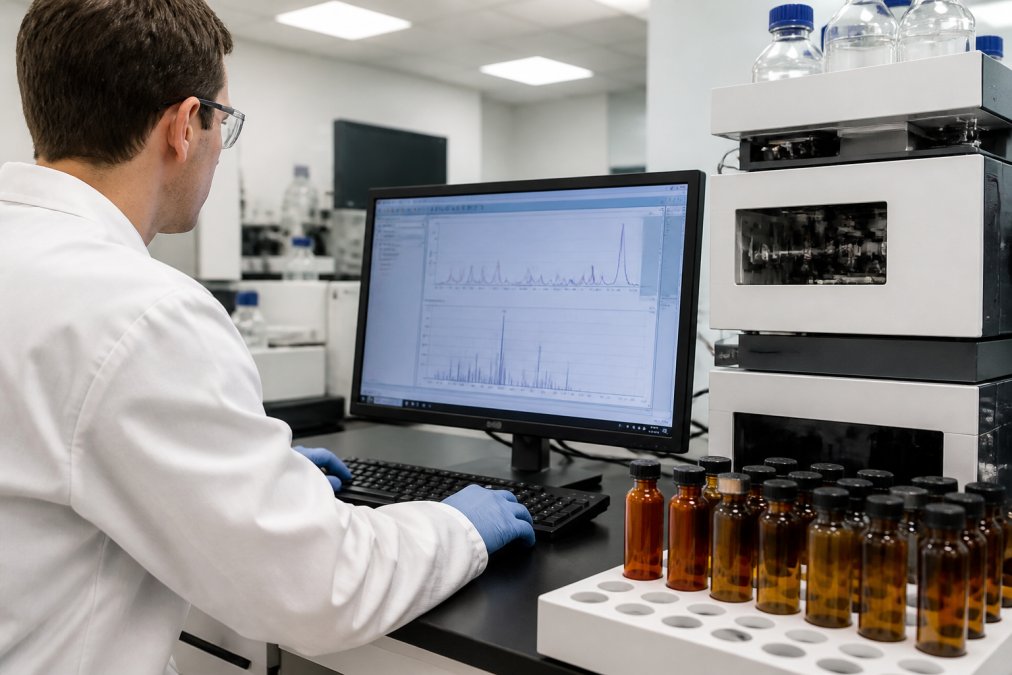
HPLC and mass spectrometry are the two most common verification methods. HPLC separates peptide molecules through a column to show purity profile. Mass spectrometry measures exact molecular weight to confirm identity. Neither alone is sufficient.
Reading Chromatogram Peaks and Retention Times
A chromatogram plots time (horizontal axis) against signal intensity (vertical axis). Each peak represents a compound. A good batch shows one dominant, sharp peak (your peptide) with minimal surrounding peaks (impurities).
Retention time is when the peak appears, measured in minutes. The same peptide always elutes at the same time under identical conditions. Different retention times across runs signal equipment, method, or sample changes.
Look for: main peak height relative to impurities, peak width and symmetry, baseline noise, and consistency across runs.
Understanding Mass-to-Charge Ratios and Molecular Weight
Mass spectrometry breaks peptides into charged fragments. The mass-to-charge ratio (m/z) indicates fragment weight relative to charge. For a known peptide sequence, MS data should match the predicted molecular weight. Mismatches indicate wrong sequence or degradation.
Look for: molecular ion peak at expected m/z, isotope pattern matching theory, fragment ions consistent with structure, and absence of unexpected high-intensity peaks.
Peptide Certificate of Analysis Interpretation
A Certificate of Analysis documents what was tested, how, and the results. Thorough CoAs provide specific data; weak ones offer only vague percentages.
What Each Section of a CoA Tells You
Lot Number and Date: Verify the lot number matches your order and testing date is recent (within weeks, not months).
Purity Analysis: Reported as percentage by HPLC. Research-grade peptides typically meet 95% or higher; specialized applications may require 98-99%.
Identity Confirmation: Molecular weight from MS should match theoretical value within 0.1% error. Larger discrepancies indicate wrong peptide or degradation.
Analytical Methods Used: CoA should name techniques (HPLC, MS, or both) and reference method standards or conditions.
Lot Release Statement: Qualified release means batch met all specifications; conditional release means it passed with exceptions.
Verifying Lot Number and Traceability
Traceability, tracking peptides from raw materials through manufacturing to your lab, is critical for research integrity. A complete CoA includes lot number, manufacturing date, expiration date, raw material codes, equipment used, and personnel initials. This enables you to identify the synthesis run, materials, and equipment involved if a batch fails.
Analytical Testing Methods Overview
Two main methods dominate peptide analysis. Understanding what each one does helps you interpret results correctly.
High-Performance Liquid Chromatography (HPLC) Explained
HPLC pushes samples through a column packed with beads. Compounds stick for different durations; a detector measures signal as they exit, producing a chromatogram with peaks for each compound.
HPLC measures overall purity, quantifies target peptide percentage, detects degradation and byproducts, and shows reproducibility across batches.
Method conditions (temperature, solvent, flow rate) affect results. A good CoA specifies these so you understand what was measured.
Mass Spectrometry (MS) for Identity Verification
Mass spectrometry ionizes molecules and measures weight, the gold standard for peptide identity. It ionizes peptides, separates by m/z, and detects ions to produce a mass spectrum. For known sequences, MS confirms the sample matches predicted molecular weight. Deviations over 0.1% indicate wrong peptide or degradation.
Peptide Stability Testing Protocols and Degradation Analysis
Stability testing measures how long peptides remain pure under real conditions. Heat, light, moisture, and oxidation cause degradation; stability studies quantify the rate under controlled conditions.
Storage and Handling Impact on Batch Stability
Storage conditions directly affect shelf life. Proper storage: 2-8°C (refrigerated) or -20°C (frozen), protected from light, sealed with desiccant, under inert gas. Degradation accelerates at room temperature; peptides stable for months at -20°C may degrade in weeks at 25°C. Moisture promotes hydrolysis; sealed, desiccated storage extends shelf life.
Incubation Studies and Precipitation Detection
Stability studies use elevated temperature to accelerate degradation, revealing months of change in weeks. A typical study stores samples at 40°C or higher, tests at intervals, measures purity loss by HPLC, and checks for precipitation. Precipitation indicates instability; absence of it at expected storage conditions is a good sign.
Independent Third-Party Validation and Raw Material Quality Control
Testing your own peptides is convenient. Testing through an independent lab is more reliable.
An independent lab has no financial incentive to inflate your results. They follow strict standard operating procedures. Their equipment is regularly calibrated. Their staff are trained specifically in analytical chemistry.
ISO/IEC 17025 Certification and cGMP Standards
ISO/IEC 17025 is an international standard for testing laboratory competence (NIST Quality System | NIST). Labs that hold this certification have been audited by accredited bodies. They follow documented procedures. Their equipment meets accuracy standards. Their results are defensible.
cGMP (current Good Manufacturing Practice) is the regulatory standard for pharmaceutical and research compound manufacturing (the FDA). It covers raw material sourcing, equipment maintenance, staff training, and documentation.
When you see a CoA from an ISO/IEC 17025 certified lab using cGMP methods, you’re looking at results you can trust. The testing was done under controlled conditions by trained analysts using validated equipment.
Minuteman Peptides uses independent US-based ISO/IEC 17025 certified third-party testing for every batch. That means your CoA reflects actual testing by an accredited lab, not internal results that lack external verification.
Cost-Benefit Analysis of Independent Testing
Independent testing costs more than internal testing. Is it worth it?
The answer depends on your research goals and timeline. If your work depends on reproducible results across multiple batches, independent testing is essential. A single bad batch can waste months of work. The cost of testing is small compared to the cost of failed experiments.
For pilot studies or preliminary work, less rigorous testing might be acceptable.
Building a Batch Consistency Testing Protocol for Your Lab
A testing protocol is your standard operating procedure for verifying peptide quality. It documents what you test, how often you test, and what results you accept.
Step 1: Define Your Purity and Identity Requirements
Start by deciding what “good enough” means for your research.
Ask yourself:
- What purity level does my work require? (95%, 98%, 99%?)
- What margin of error can I tolerate in molecular weight?
- How sensitive is my assay to impurities?
- What degradation products would invalidate my results?
Step 2: Establish Standard Operating Procedures
Write down exactly how you’ll test each batch.
Your SOP should include:
- Which analytical methods you’ll use (HPLC, MS, or both)
- Which lab will perform testing
- How you’ll document and store results
- Who approves batches for use
- How you’ll handle out-of-specification batches
Consistency matters. Testing the same way every time makes it easy to spot problems. If you switch methods or labs midway through a study, your results become harder to interpret.
Step 3: Schedule Routine Testing and Stability Assays
Don’t test only when you receive a batch. Test periodically as you use it.
A simple schedule:
- Incoming batch: full testing (HPLC + MS)
- Monthly during use: purity check by HPLC
- Before long-term storage: stability baseline
- After storage: confirm no degradation
Step 4: Document and Track Results Across Batches
Keep a log of every test result. Track lot numbers, dates, purity values, and any deviations.
Last Updated: September 19, 2026
Frequently Asked Questions
What is the gold standard for peptide purity testing?
High-performance liquid chromatography (HPLC) combined with mass spectrometry (MS) represents the gold standard for peptide purity testing. HPLC separates peptide components by retention time, while MS identifies molecular weight and sequence identity with high precision. Independent third-party validation using ISO/IEC 17025 certified laboratories ensures objectivity and regulatory compliance. This two-method approach catches both major impurities and trace contaminants that single-method testing might miss.
How do I know if a Certificate of Analysis is trustworthy?
Verify that the testing laboratory holds ISO/IEC 17025 certification, which demonstrates compliance with international standards for competence and impartiality. Check the CoA for specific data: retention times, mass-to-charge ratios, lot numbers, and incubation dates. Cross-reference the reported purity percentage with the chromatogram peak areas. Legitimate providers include detailed impurity profiles and degradation analysis. Request the raw HPLC and MS data if your research requires it, and confirm that testing was conducted by a third party independent of the manufacturer.
Why should I use third-party testing instead of relying on the manufacturer’s results?
Third-party ISO/IEC 17025 certified laboratories provide independent verification that removes conflicts of interest. A manufacturer has financial incentive to report favorable results, while an independent lab has no stake in your purchasing decision. Third-party testing also ensures standardized procedures and reproducibility across different batches and suppliers. For research requiring regulatory compliance or publication-grade data, independent validation is often mandatory and strengthens the credibility of your results.
How often should I retest peptide batches for stability?
Stability testing frequency depends on your storage conditions and research timeline. Standard practice involves baseline testing upon receipt, then testing at defined intervals (often 3, 6, and 12 months) if batches are stored long-term. Accelerated stability assays using elevated temperatures and humidity can predict degradation faster. Document storage temperature, light exposure, and humidity for each batch. If you’re using a batch over 18 months, quarterly stability assays help catch unexpected degradation before it compromises your research.
ISO/IEC 17025 standard for laboratory competence
FDA guidance on cGMP for pharmaceutical manufacturing
A2LA accreditation database for US testing laboratories